

1. Bears
Women are horny for Wicker. Alexander Skarsgård plays a husband literally woven from wicker for an unmarried fisherwoman played by Olivia Colman, and the early reaction suggests that the basket is not exactly getting in the way. The joke is that women would apparently desire Skarsgård even as furniture. But Wicker belongs to a much older fantasy in which women fall for creatures, beasts, masks, corpses, and bodies that are recognizably male without being entirely human.
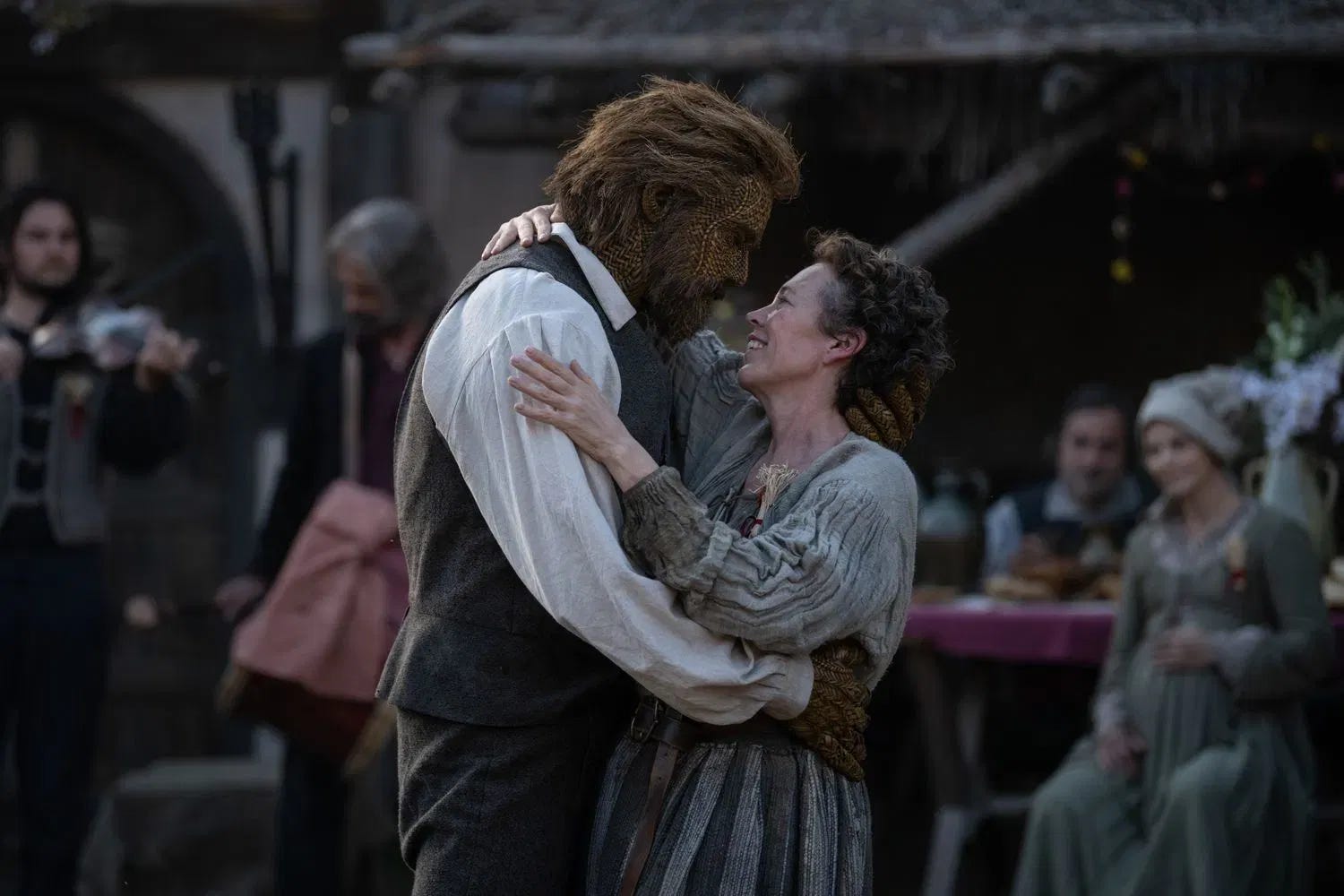
It also makes a strangely perfect companion to Curry Barker’s Obsession (2026). Bear wishes that Nikki will love him more than anything in the world, effectively replacing a real woman’s will with his fantasy of her. At first glance, Nikki and Wicker seem symmetrical: a woman created for a man and a man created for a woman. They are not. Wicker gives material form to a woman’s fantasy, while Nikki already exists and must be overwritten to satisfy a man’s.
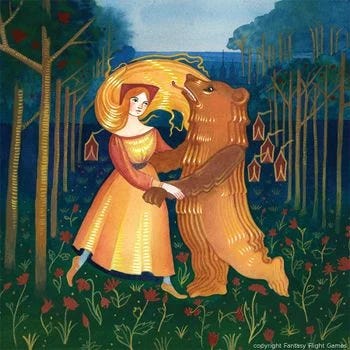
Bear’s name makes the transition almost irresistible. Only a few years earlier, women online were asked whether they would rather encounter an unknown man or a bear alone in the woods. The preference for the bear was never really about zoology. The bear is dangerous, but its danger is visible. It does not pretend to be anything else. Patrick Bateman in American Psycho represents the opposite horror. He has, as he puts it, “all the characteristics of a human being: flesh, blood, skin, hair,” while everything recognizably human beneath that surface has disappeared. Bateman looks like a man and conceals the monster. The bear looks like a beast and makes no such promise.
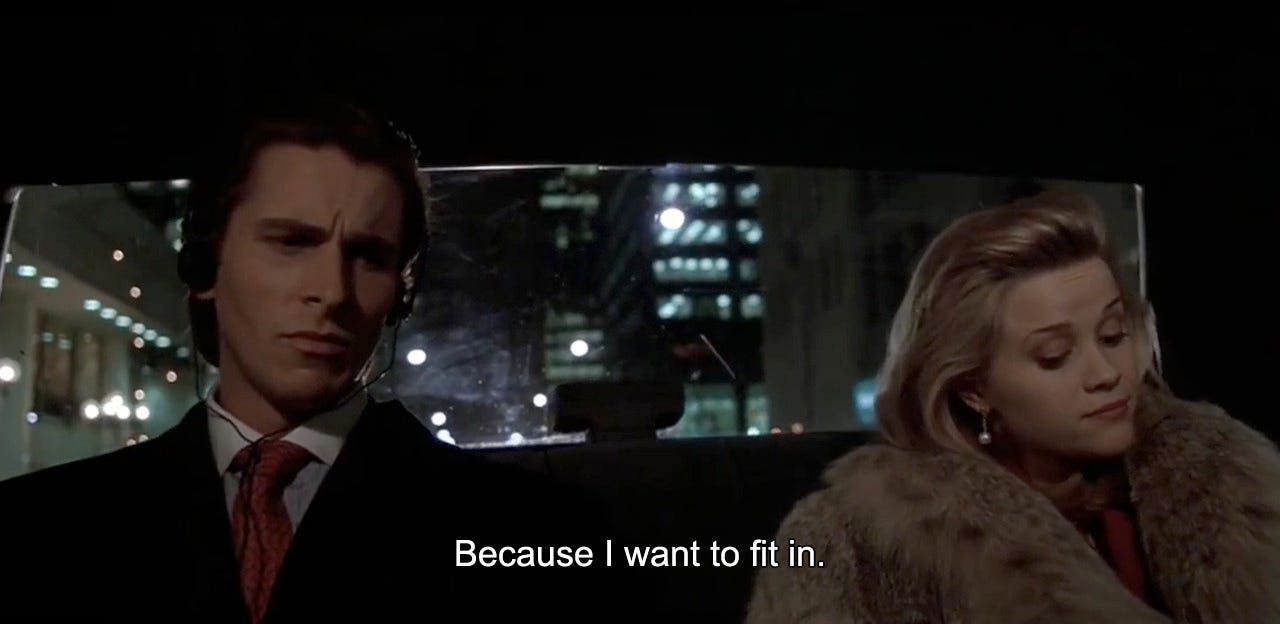
That distinction connects Obsession to Wicker. Western stories have repeatedly imagined men constructing women, from Galatea and Hoffmann’s Olimpia to Metropolis, Her, and Ex Machina. The fantasy asks whether the desired woman can be made more perfect, more predictable, more controllable. Monster romance often moves in the opposite direction. Women look at something that should not be a man at all and ask whether there might nevertheless be a man inside it.


2. The Monster
Beauty and the Beast provides the basic structure. Beauty sees humanity where everyone else sees an animal, and the story eventually rewards her by revealing the prince. Guillermo del Toro’s The Shape of Water (2017) updates the fantasy by removing that reward. Elisa falls in love with the Amphibian Man as a creature. He does not need to become conventionally handsome or even conventionally human. Del Toro’s Frankenstein similarly asks us to find emotional humanity inside a visibly manufactured body, while Batman offers a softer version of the same visual language: the ordinary male body disappears beneath mask, armor, trauma, and an animal identity.
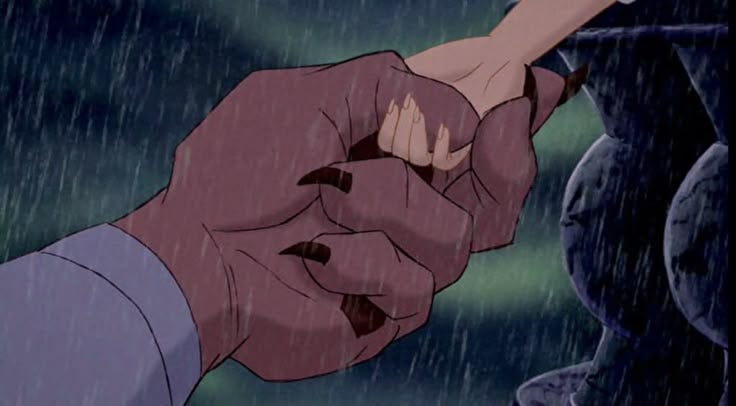
These figures all make masculinity unusually legible. The things ordinary men might conceal become visible on the monster’s body. Anger becomes claws, emotional isolation becomes a castle or a mask, trauma becomes scars and armor, vulnerability becomes a curse. The woman’s role is therefore not simply to “fix” him but to interpret him. She sees tenderness beneath aggression, pain beneath silence, humanity beneath monstrosity.


That fantasy has an obvious relationship to emotional labor. Patriarchal masculinity has often encouraged men to hide vulnerability while expecting women to discover and care for it. Fairy tales make that labor magical. An emotionally unavailable boyfriend is exhausting. A Beast under a curse is romantic because his silence has an explanation, his wounds can be deciphered, and the woman’s understanding can actually transform him.
Recent monster romances complicate the old formula further. The Amphibian Man remains amphibious. Frankenstein’s Creature remains stitched together. Wicker remains wicker. Increasingly, the fantasy is not that the monster will become a normal man, but that he may already be desirable without doing so.
3. Vestimentary Animals
Long before women kissed monsters on screen, fashion placed women in remarkably intimate relationships with animal bodies. In my research on what I called vestimentary animals, I examined nineteenth- and early twentieth-century fur accessories that remained visibly animal after becoming clothing. Collars retained heads, paws, tails, and glass eyes. Muffs acquired faces. Several pelts could be chained together. The animal became an object without completely ceasing to appear as an animal.
Fashion historian Julia Long has described such accessories as “portable pets.” Chains, collars, and muzzles normally associated with living animals were attached to dead ones, while taxidermic techniques restored faces and eyes. The result was a kind of reanimation. A skin became a companion again, or at least performed the appearance of one.
The gendered difference is striking. Men more often displayed animal trophies on walls or turned them into furniture. Women carried recognizable animal bodies directly on themselves in public. Their boas and collars became increasingly animal-like until the manufacturing process almost seemed to reverse itself: the animal became material, and then the material grew a face again.


The word naturalización, historically used in connection with taxidermy, captures this transformation particularly well. Naturalization can mean incorporating something foreign into a new community, domesticating it, or preserving an animal as if it were still alive. Monster romance follows the same logic. Beauty brings the Beast into the sphere of love. Elisa brings the Amphibian Man into domestic intimacy. The strange creature becomes companion.
Yet women wearing animal bodies were also repeatedly described as animal themselves. Fashion critics turned them into Harpies, Sirens, predators, and hybrids. The woman could humanize the animal while becoming less human in the eyes of the culture judging her. That movement in both directions matters. Monster romance does not always end with the woman dragging the beast toward civilization. Sometimes she crosses toward him.


4. Her Herculean Emotional Labor
The artificial woman and the desired monster form an oddly symmetrical pair. One fantasy starts with the female body and asks whether the will inside it can be controlled. The other begins with a body that should not be desirable at all and searches for an interior worthy of love.
That does not mean men naturally want artificial women or women naturally want monsters. These are cultural fantasies, useful precisely because they exaggerate familiar gender arrangements. The artificial-woman story imagines female unpredictability disappearing. Monster romance turns the emotional opacity of masculinity into something visible and interpretable.
The risk is obvious. Not every Beast contains a prince, and believing that sufficient love will reveal the “real man” beneath cruelty can become its own trap. Bateman is the warning: a perfectly human surface can conceal nothing worth rescuing.
But the newer fantasy suggests something more interesting than “I can fix him.” Perhaps the monster does not need to be fixed at all. Perhaps the point is that humanity, tenderness, and desirability were never guaranteed by the ordinary male body in the first place.


Men have repeatedly imagined the perfect woman by creating her.
Women keep looking at the beast and asking who is inside.
And increasingly, they seem less concerned with turning him back into a man.